Beyond the Linear: Core Principles of Circular Fashion
Fashion runs mostly on a one-way line from raw material to bin. Here is what circular fashion means, and its three guiding principles.
In the first article of this series I asked what circular fashion actually is, and why it matters. This is where we start answering that. Before exploring practical things we can do and policy solutions, it helps to have a clear picture of the idea underneath it all.
The straight line we are all inside
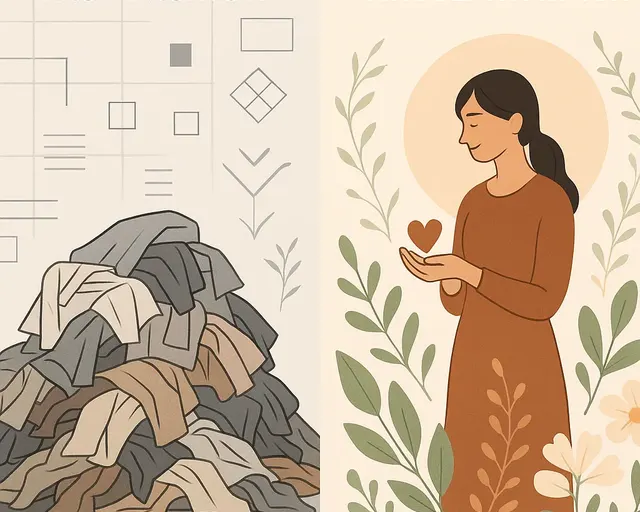
Picture a one-way street. Raw materials go in at one end, they are made into clothes, we wear them for a while, and then they leave through a bin at the other end. That is the "take, make, dispose" model, and most of the fashion industry still runs on it. Nothing in it is designed to come back.
Circular thinking bends that street into a loop. The aim is simple to say and hard to do: keep clothes and materials in use, at their best value, for as long as possible, and stop creating waste in the first place.
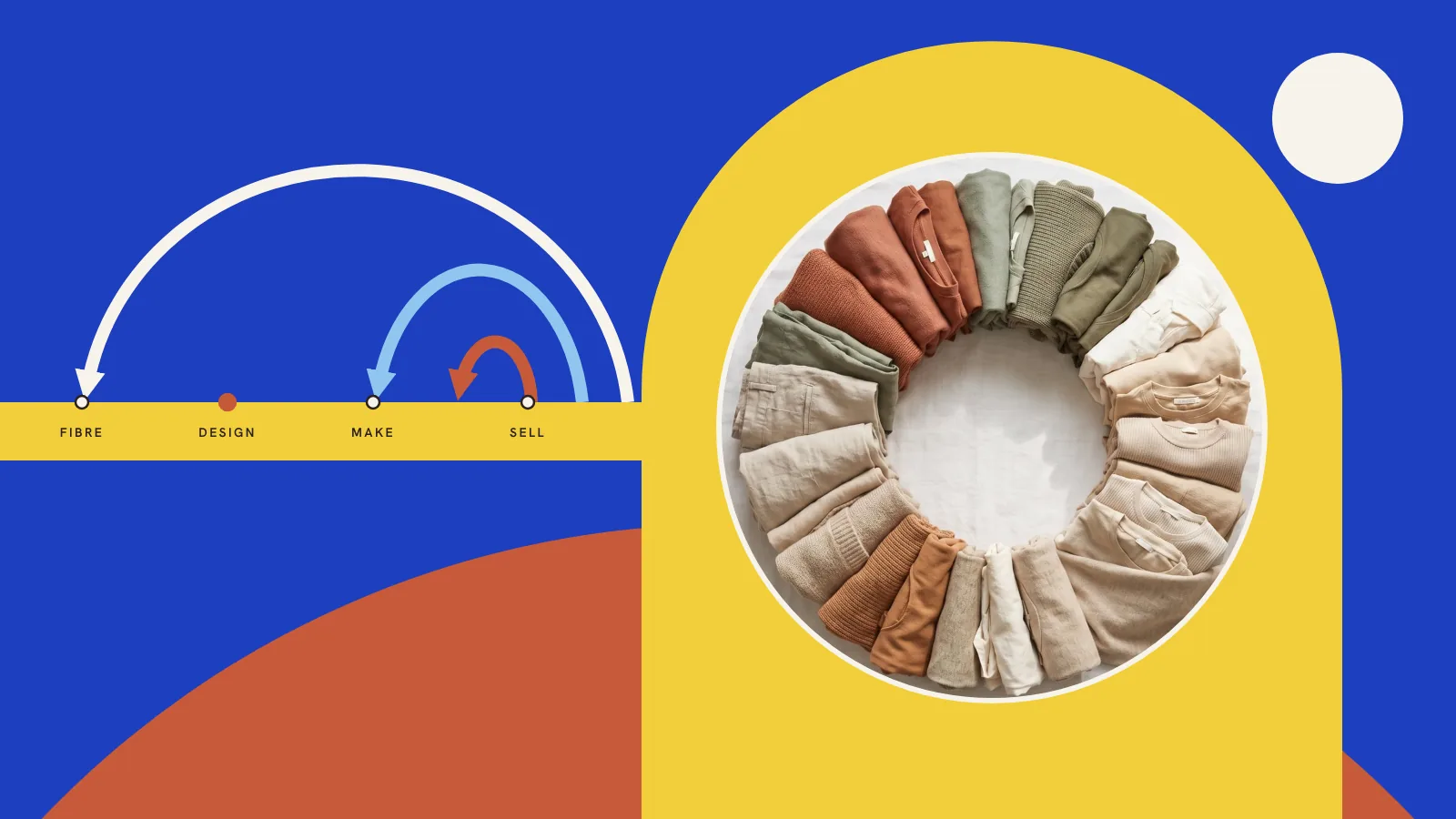
What circular fashion could look like.
Here is the whole picture on one page: the straight line in yellow, and the four loops that bend it back, tightest first. The tighter the loop, the more value it keeps.
The loops, and who's turning them
Better beginnings
Fibres that can go back to soil or back into the loop, plus leftovers from food and fishing. Bottle-to-shirt polyester is falling out of favour — those bottles are better kept in their own loop.
Case study: Vegea — a leather alternative made from grape marc left over from winemaking.
Virgin fossil synthetics
Brand-new polyester, nylon and acrylic, made straight from oil and gas. Cheap and everywhere — and where most of the breaks in the loop begin: they shed microfibres in the wash, get blended into fabrics that are hard to separate for recycling, and rarely come back as new clothes.
The shift: durable, single-fibre designs, and polyester recycled from old textiles rather than drilled for.
Decided at the drawing board
Up to 80% of a garment's impact is set before it's sewn. One fibre per fabric so it can be recycled; buttons and zips that come off easily for sorting; seams built to last and be mended; and a digital passport that tells the next owner — or recycler — exactly what it's made of.
Case study: the Ellen MacArthur Foundation's Jeans Redesign — guidelines for denim that lasts, is made safely and can be recycled.
Care & repair
The tightest loop and the cheapest. Every extra wear dilutes a garment's footprint; repair is becoming a service you book, not a chore you dread.
Case study: France's Bonus Réparation, which knocks a set amount off clothing and shoe repairs at approved menders.
Resell & rent
Same garment, new wardrobe. Resale is now mainstream, and more brands run their own take-back and second-hand shops.
Case study: Vinted and Vestiaire Collective for peer resale; Patagonia Worn Wear for brand take-back — trade in used gear for credit, and it's cleaned, repaired and resold.
Remake & upcycle
Cut, rework, rebuild — from deadstock, factory offcuts and worn pieces — so the fabric's value goes up, not down.
Case study: UPMADE, a method and certification for designing new collections from factory leftovers.
Recycle fibre-to-fibre
When it can't be worn, return the fibre. Automated sorting reads blends; chemical recycling turns cotton-rich waste into pulp and breaks polyester back down to new yarn.
Case study: Circulose — formerly Renewcell, restarting its Swedish plant after the 2024 bankruptcy — and Syre for textile-to-textile polyester.
Untangling the blends
Polyester-cotton is why so much ends up as rags: until now, separating it destroyed one fibre or the other. New chemistry recovers both, and infrared sorting with machine learning can finally read what a garment is made of. The hard part now is scale — and buyers for the output.
Case study: Circ — building a plant in Saint-Avold, France, to recycle 70,000 tonnes of polycotton a year, targeted for 2028.
Cascade, then the bin
Downcycling into rags and insulation buys time, not a loop. Burning for energy and landfill are where the system still fails.
The good news: every better input, every untangled blend and every turn of the four loops shrinks this leak a little more. The more of them we adopt, the less there is left to bury or burn.
2030 target: the EU textiles strategy aims for clothes that are long-lived, recyclable and largely made of recycled fibres — with landfill and incineration reduced to a minimum.
What "circular fashion" means
The term was shaped by Dr Anna Brismar, who set out the concept in 2014 and built it on the wider circular economy. In plain words, her idea is that clothing, footwear and accessories should be designed, sourced and made to be used and recirculated responsibly for as long as possible at their highest value. When people truly no longer need them, they should return safely to nature rather than linger as waste.
A few principles run through her definition:
- Know where a garment comes from, what it is made of and who made it.
- Design out waste and pollution, with durable, timeless pieces.
- Respect the people and animals involved in making it.
- Keep items in use through repair, swapping, reselling and repurposing.
- Keep production clean, so what cannot be reused can safely go back to nature.
The three pillars
The Ellen MacArthur Foundation, one of the leading voices on the circular economy, frames it around three principles. Here is how each shows up in fashion.
1. Eliminate waste and pollution. The cheapest waste to deal with is the waste you never make. The Foundation's Jeans Redesign guidelines, launched in 2019 with more than 40 denim experts, set minimum standards for jeans: they should survive at least 30 home washes, avoid hazardous chemicals and be designed so they can be taken apart and recycled. Brands including Gap, H&M Group, Lee and Reformation signed up.
2. Circulate products and materials. Once a garment exists, keep it moving. Patagonia's Worn Wear programme is a good example: it offers repair guides, trades in used gear for store credit, resells used pieces and takes back items that are beyond saving. Rent the Runway shows another route to reuse, letting customers rent clothes through subscription plans or one-off rentals instead of buying outright.
3. Regenerate nature. Circular fashion is not only about stuff going round. It is also about the land the fibres come from. The same Jeans Redesign guidelines ask that jeans are made mostly from cellulose fibres, such as cotton, grown with regenerative, organic or transitional farming methods.
The cheapest waste to deal with is the waste you never make.
Where this points
It all comes down to one thing: making second-hand the go-to, not the last resort. In the next article, we’ll get practical with easy wins you can try today, from simple mending to renting and swapping clothes.
Read Article 3: Quick Wins for a Circular Wardrobe: Easy Steps You Can Take Today
And if you’re interested to learn more, check out the rest of the articles in this series:
- Read Article 1: Where Does Fashion Go to Die?
- Read Article 4: Building a Truly Circular System: Systemic Shifts for Long-Term Impact
- Read Article 5: Circular Fashion for All: Luxury vs. Low-Cost
- Read Article 6: Looking into the Future: AI & Transparency
- Read Series Intro: From Fast Fashion’s Graveyard to a Circular Tomorrow: A Fast Fashion PM’s Wake-up Call
- Guap — Dr Anna Brismar's concept of circular fashion explained
- Wikipedia — Circular fashion
- Ellen MacArthur Foundation — Eliminate waste and pollution
- FourWeekMBA — Rent the Runway business model
- Ellen MacArthur Foundation — A new textiles economy (under 1% recycled into new clothing)
- Ellen MacArthur Foundation — #WearNext (73% of clothing materials landfilled or burned)
- European Commission — Circular Economy Action Plan (up to 80% of impact set at design)
- EURATEX — Separate textile collection from 1 January 2025
- European Commission — Revised Waste Framework Directive and textile EPR, Oct 2025
- Anthesis — ESPR ban on destroying unsold apparel and footwear from 19 July 2026
- Smartlinks — Digital product passports for textiles from 2027
- Textile World — Altor acquires Renewcell, renamed Circulose
- Dealroom — Circulose plans to restart operations by end of 2026
- H&M Group — Syre and the move away from bottle-to-textile polyester
- Refashion — Bonus Réparation press kit (€6–25 per repair)
- Ellen MacArthur Foundation — The Jeans Redesign guidelines
- Vegea — GrapeSkin, a bio-based material from grape marc
- Reet Aus — UPMADE® industrial upcycling certification
- Vinted
- Vestiaire Collective
- Patagonia — Worn Wear trade-in and resale
- Circ — Polycotton separation technology
- Textile World — Circ plant in Saint-Avold, operations targeted for 2028
- REMADE Institute — Automated sorting with infrared spectroscopy and machine learning
- Forbes — How the fashion industry can scale up textile recycling (Oct 2026)
- European Commission — EU Strategy for Sustainable and Circular Textiles (2030 vision)